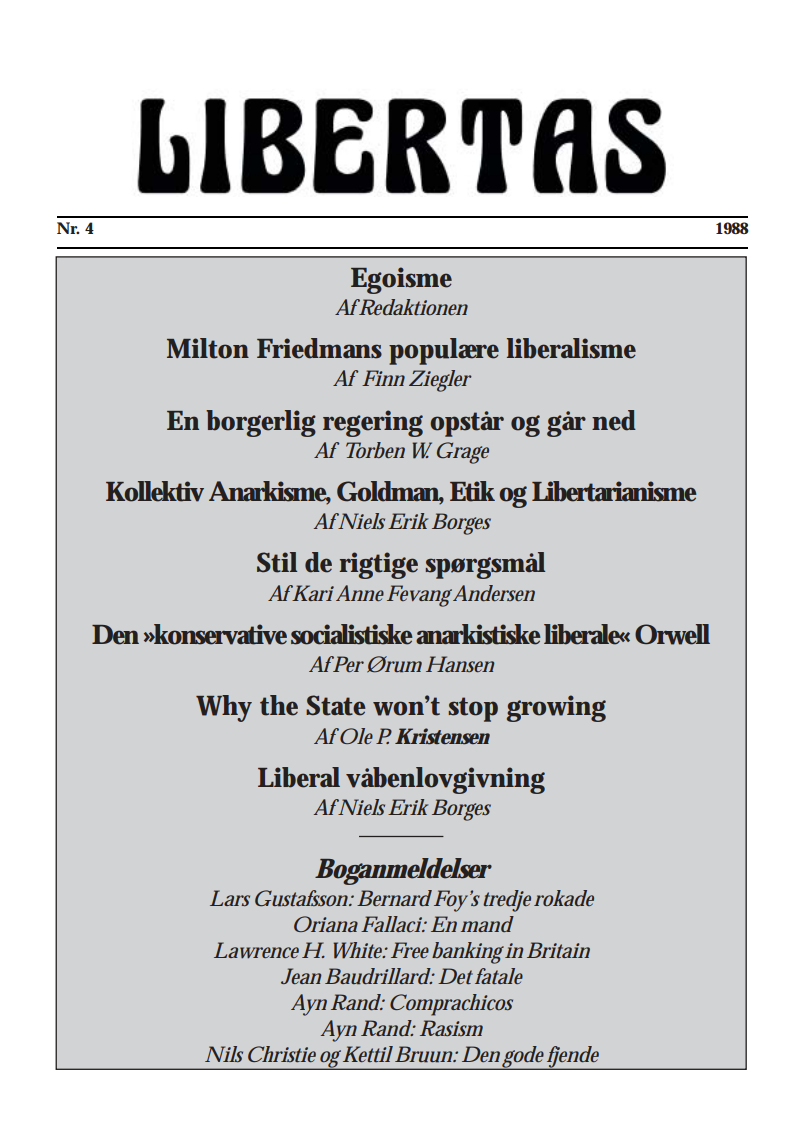
Why the State won't stop growing, Libertas Nr. 4
By Ole P. Kristensen
Edited by Otto Brøns-Petersen
Marts 1988
In his recent book »Væksten i den offentlige sector« (The Growth of the Public Sector), professor Ole P. Kristensen of Århus University argues that the expansive public sector growth in the Western world has been caused by the system itself rather than a broad consensus or socio-economic factors. While pressure in favour of more public spending often can be considered as »private good« for various special interest groups – such as civil servants – pressure against more spending is often a »public good«. Thus, as the case tends to be with other public goods, pressure against public spending is »undersupplied«.
The consequences of a large public sector are viewed as very negative. Denmark and other welfare states are suffering from »government overload« and in an important sense increasing state power is anti-democratic. The popular understanding of the term 'democracy' is that ressources are used according to individual preferences, but whereas the market secures such an allocation, the public sector doesn't.
The book ends on a rather pessimistic note. »Feasible reforms are not important, and important reforms are not feasible«, Kristensen concludes.
The book constitutes the main part of Kristensen's doctoral dissertation in political science. The following is an extract from the author's own English summary, edited by Otto Brøns-Petersen.
Kristensen starts out to reject the widespread opinion that the expansive growth of the public sector is mainly a result of either political references on part of the population or socio-economic factors, ie. that public sector »products« have a high income elasticity. Not only are these explanations weak on their own premises. They are wrong kinds of explanations, put forward because theorists confuse the working of the public sector with the working of the market. Political or socio-economic factors cannot by themselves change public spending, they have to be transmitted by decisions in the political and/or administrative system. Thus, the institutional factors surrounding public decision making play a crucial role.
Three basic or fundamental features of the public sector and the political system contributes to the fact that public spending does not in a simple way mirror »the will of the people«. The public sector is governed by a collective decision-making system, that is, decisions are collective in the sense that individuals do not have the power of veto, not even in relation to issues where they are directly affected. Secondly, the public sector is funded by collective contributions in the form of taxes, and so a separation between the activity and its funding exists. Finally, the output from the public sector is not measured by some institutional built-in mechanism.
The Asymmetrical Nature of Public Spending Decisions
The most general proposition concerning the institutional factors and public-spending presented claims that institutional features of the public sector and the political system imply a basic asymmetry in public decisions favouring higher rather than lower spending. This proposition is derived from the basic institutional features described above.
The first and maybe most important precondition for the asymmetry is the separation of funding from activities in the public sector. The activities are funded collectively and the institutions of finance are in no specific way related to the activities they are supposed to fund. This separation of costs and benefits from public activities are crucial for spending decisions. It makes the economic demand model, often used to explain public sector development, irrelevant from institutional reasons. The economic demand model is based upon a quid pro quo funding system which is not usually found in the public sector. The demand is not even useful to analyse the narrow relationship between a political sponsor organization and a bureau. That, however, is not due to the system of funding, but to another basic feature of the public sector: Output is not measured in any exact way, and so the perception of the amount and quality of the output may be object of political manipulation and discussion making possible the »flattening« of the cost curve as a tactics to promote spending.
The separation of activities from their funding combined with the attributes of the political-bureaucratic decision-making process creates an asymmetrical incentive structure around public spending decisions. The benefits from a specific public activity is relatively concentrated around groups of public employees and »clients«, while the costs in the form of taxes are dispersed among all tax payers. The costs of public activities may be characterized as a (negative) collective good while the benefits are rather private in the economic meaning of those two words. Because of this, »the spending« coalitions tend to be well organized and articulated while the coalition trying to impose austerity and oppose tax increases is badly organized and not well articulated.
Important in the spending coalitions are almost always »the professional bureaucratic complex«. But other actors including organized interests, politicians with a special interest in the issue in question, and segments of the electorate participate also. The strength of the asymmetry, however, depends on the specific institutional characteristics.
The asymmetry proposition is of a rather general and abstract nature, which only indirectly may be tested empirically. The asymmetry influences the attitudes and perceptions concerning public spending of all political actors ranging from voters to cabinet members. The decision-making process will be patterned by the asymmetry, especially in terms of which actors participate in which decisions. Finally public spending proper will be affected. The features of the decision-making process will not be dealt with here. That topic is well-known from a comprehensive body of research, showing that the affected interests always tend to be more than proportional represented, which was to be expected from the asymmetry proposition.
Voter Attitudes and Public Spending
If the median voter model was a good and valid description of how spending decisions are made, no room would be left for the independent influence from institutional factors, and so it is important to »disprove« the median voter model when an independent importance of institutional factors is a major proposition. One drawback of the median voter proposition is that public policy is not solely determined by elections and election outcomes, and voters have other means of influence than elections. The median voter model is an »exit« based model but »voice« certainly also is very important in politics.
The median model is tested empirically by Danish survey data containing information of voter attitudes towards public spending for a number of specific purposes. In all cases the level of spending deviates substantially from the preferences of the median voter. In all cases the spending level is too high or too low when the median voter is used as a benchmark.
These results are, however, not a major feature of the book, but are dealt with in an earlier article (OPK, 1982). The article shows that alltogether the asymmetry proposition is supported by the attributes of voter attitudes towards public spending, and in general politically active voters probably add to the pressure for higher public spending.
Attitudes and Perceptions of Bureaucrats, Politicians and Officials of Interest Organizations
The author treats spending attitudes and preferences among civil servants in the Danish central administration, among members of parliament and among officials from interest organizations. The data are based upon surveys. The purpose is to illustrate the same kind of phenomena as was found among the voters plus some attributes especially related to the particulars of the roles of bureaucrats, members of parliament and interest organizations.
First, the expected role of the professional bureaucratic complex is confirmed. Bureaucrats in general think that »their« budget should be increased. They also perceive their role as to ensure solutions which are as close to perfection as possible. They do not perceive any particular responsibility for total public spending.
In a political system life the Danish, where interest organizations play a crucial role, one might argue that these organizations belong to the professional bureaucratic complex, at least when the complex's role in relation to public spending is considered. This is confirmed by the survey. Interest organizations are almost exclusively involved in decisions concerning substantive issues, that is spending issues, but not in issues of making priorities and providing funding. Activity on the part of interest organizations almost exclusively means pressure for higher spending. The survey shows that it is a rare event to see an interest organization propose cut backs. When they do, the impact may be small, because cut back proposals often relate to issues outside what is considered the legitimate sphere of interest of the organization in question, e.g. the teacher's union saying that no cut backs are possible within the educational system, but they should not be surprised if resources are wasted in the army.
It is a crucial part of the asymmetry that albeit overall cut backs and tax reductions are seriously wanted (a collective good is wanted) it may be quite impossible to translate that wish into specific and political viable cut back proposals, because specific cut backs will hurt some private interests. The survey confirms that pattern in terms of attitudes and perceptions among bureaucrats and politicians. The pattern prevails whether the professional bureaucratic complex is on the offensive or in the defensive.
So far, the civil service has been treated as one homogenous body. The reality is, of course, different. First and foremost there exists a department of the budget (or a similar institution) whose major task is to guard the public purse. Is the department of the budget not able to counterbalance the asymmetry? The civil servants of the department of the budget express some frustration. They are not able to enforce as much austerity upon the spending department as they perceive reasonable.
As in the case of the voters all this add up to lack of consistence between the attitude towards total spending and item-by-item. The former is perceived to be too high while the latter is to small. This holds true for as well bureaucrats as for members of parliament.
Altogether the indications of the asymmetry may be found at the attitudinal and perceptional level.
Actual Public Spending
The strength of the asymmetry may vary by the specific attributes of public activities. So everything else equal, institutional factors will make some expenditures rise faster than others.
The asymmetry will be less pronounced for expenditures on transfer payments than on public consumption expenditures for at least two reasons. The professional bureaucratic complex has almost nothing at stake in relation to transfer payments, which are made directly to the citizens with only modest use of public employees. It is different for public consumption expenditures which directly influence the number of employed from the professional bureaucratic complex and their working conditions. So the complex may be supposed to be far more active concerning expenditures for public consumption. Secondly, the decision-making processes concerning transfer payments are in practice often more centralized than decision-making concerning public consumption expenditures. Decisions which imply increased public consumption may be very decentralized, e.g. made at and only valid for a particular public institutions. When decision-making is centralized the costs of increased spending becomes more visible and less marginal and so makes it more likely that cost considerations gain weight and hence reduce the asymmetry.
This proposition may seem strange as it is evident that transfer payments in the OECD countries recently has grown more quickly than consumption expenditures. This overall pattern may be spurious, however, caused by the influence of political and economic factors. Those factors have meant relative changes in the purposes for which public money is spent. Defence spending has declined in relative terms in most developed and democratic countries while e.g. social spending has increased. The distribution between consumption expenditures and transfer payments differ widely from one public function to another. Defence spending is almost exclusively for public consumption while social spending contains a substantial share of transfer payments. So a control must be made for purpose or function when looking at the relationship between consumption spending and transfer payments.
A comparative study of social spending shows that in most countries the expected pattern is found. Consumption expenditures for social purposes has increased more than social transfer payments.
A similar pattern may be expected when consumption expenditures and capital expenditures are compared. Public spending cuts will always be opposed. If the opposition does not succeed entirely the cuts will be located where the opposition from the professional bureaucratic complex is weak, because the complex is not really hurt. Capital expenditures is thus an obvious candidate for cuts. Directly hurt are mostly private contractors and their employees, which have a very weak position in public spending decision-making compared to that of public employees. The expected pattern is overwhelmingly confirmed by the data.
The Role and Nature of the Public Sector
Obviously, some of the traditional perceptions of the role and nature of the public sector has to be revised, as they solely include economic and/or political factors as determinants of public sector activity.
In a traditional view inspired by economists the public sector is perceived a residual and a corrective to the market. Public sector activities are determined by market failures. That includes some very basic functions which among other things shall enable the proper functioning of the market itself. On top of that the existence of collective goods, externalities and natural monopolies may cause public intervention. Modern welfare states are obviously involved in far more activities than those caused by traditional market failures. So they have been supplemented with the concept of merit goods. This concept is criticized and a claim is made that this concept anyway has quite another status than market failures proper.
Market failure relates to the allocational aspect of the economy. Standards for allocational efficiency may be established by economists and so establish standards for public sector intervention. This is not the case for the distributional aspect of the economy. No economic criteria for the optimal distribution of wealth and income exists. Redistributions, however, is an important economic or economy inspired reason for public intervention in welfare states. Correction of market failures and redistribution so constitutes traditional roles of the public sector. Two comments may be made about these roles. First they relate to genuine collective problems, and so they have to be dealt with by a collective decision-making system. The last point is not uncontested, but nevertheless taken for given in most of the literature. As the public sector and the political system is a collective decision-making system, there is a nice fit imbedded in the traditional perception of the role of the public sector: a collective decision-making system to take care of collective problems.
The second comment is that the traditional perception of public sector role is not thorough. Public sector activities do not exclusively deal with genuine collective problems. So the role and nature of the public sector includes non-collective problems as well.
This point, of course, is an empirical one. But it may be related to the autonomous significance of the institutional factors for public sector development. It may be argued that the institutional factors establish a pressure which by some substantial likelyhood will imply public sector activities in relation to problems which are not genuinely collective.
Particularistic interests will try to make the public sector look after their interests. The motive for that is not least that the costs of solving some particularistic problems will be carried collectively. Because of the incentive structure it is more likely that particularistic interests will succeed in their endeavour than will genuine collective interests.
This may be formulated as a paradox: the public sector is governed by a collective decision-making system designed to take care of collective problems which cannot be handled in a satisfactory way by the individualistic market, but actually the public sector is better suited to look after particularistic interests.
One may ask how a public sector supposed to take care of collective interests, but actually especially looking after a lot of particularistic interests, can preserve its legitimacy? Several reasons are given. The prime reason probably is that public sector legitimacy depends more on procedures than on outcome or substance. It is the democratic procedures which govern the public sector that legitimize it. That actual performance is less important.
One feature about the public sector, however, remains genuinely collective: its funding. That is exactly what makes it worthwhile to let the public sector take care of particularistic interests. So one could argue that the most basic and constitutional attribute of the modern welfare state is its system of collective funding. Thus a state definition should not be one of legitimate appliance of physical violence or something like that but one of a tax state. The constitutional feature of a modern welfare state is its ability to impose taxes upon the citizens.
Tax Structure and Public Spending
The main point of the asymmetry proposition was that the costs of public activities in a systematic way is given less consideration than the benefits. This proposition does not imply that the costs can be ignored entirely. The necessity of funding establishes some kind of brake upon spending. It may be hypothesized that the strength of this brake depends on the specific features of the system of public funding, that is, the tax system. Propositions of that kind actually are of quite old standing.
One such proposition relates to the »visibility« of taxes. Some taxes are considered more visible than others. If the revenue from invisible taxes constitute a substantial share of total revenue public cost consciousness is weakened and total public spending higher than if visible taxes were dominating.
The tax structure might also be important in another respect. If explicit political decisions to increase taxes are needed to finance increased spending, opposition against higher taxes and spending is more likely than if increased funding comes around without any explicit political decisions. The need for political decisions to increase taxes depend on the elasticity of the tax system, especially during times of economic growth and inflation. Elastic taxes automatically produce higher revenue relative to the national income when the nominal national income goes up. So elastic tax systems might weaken cost consciousness and strengthen the asymmetry.
The propositions concerning visible and elastic taxes are partly contradictory as invisible taxes tend to be inelastic and visible taxes tend to be elastic. If the tax structure shall be able to contribute to the explanation of comparative public spending differences, tax structure must differ among nations. It is shown that the tax structure differ widely among the OECD-member countries. So the independent variable do vary.
A comparative statistical analysis show that the predicted association between spending and visibility is absent. Generally the relationship is weak and sometimes even with the wrong sign. The finding is probably due to the limited capacity of invisible taxes to raise revenue. The long term trend, while public spending skyrocketed, has been less and less reliance on the rather traditional invisible taxes.
The proposition on tax elasticity and public spending is supported by the data. That is, in the years before the economic crisis starting around 1974, the proposition is supported. Big public spending is correlated with heavy reliance upon elastic taxes. During the years of economic recession the associations vanish. Actually this pattern is in accordance with the proposition. Only during years of rapid economic growth does an elastic tax system automatically provide growing revenues.
The data show that during the years of recession those nations rely on a variant of the invisible tax proposition instead. They try to conceal the costs of public spending by turning to deficit budgeting. After some years of recession a substantial correlation between public spending and the size of the budget deficit emerges. No such association existed in the boom years.
The overall conclusion is that the system of public funding is related to the level of the spending. Big public spending is to some degree associated with the types of funding suited to reduce the perceived costs and so suited to promote some kind of fiscal illusion.
Cost Effectiveness of the Public Sector
The asymmetry not only relates to the scope of public activities but also to the costs of those activities. The benefits from increased cost effectiveness in public programs are collective, while the hardship is felt by a narrow group of employees. As no institutional mechanism, like competition, forces public institutions to minimize the costs, it follows that the costs of public institutions probably are higher than the costs of performing the same activity in another institutional setting.
This proposition has quite often been tested by comparing public institutions with private companies in a competitive environment performing the same kind of task. The main methodological problem of comparisons of performance is the comparability of the output from the public institution and the private company. Is it exactly the same kind of output? Or can cost differences not be attributed to differences of efficiency but to differences of output?
Denmark provides a nice comparable case. The case in question is fire protection, which in some Danish cities and municipalities is provided by traditional public fire departments and in others by a private contractor. The two ways to organize fire protection are quite comparable.
The analysis shows that the contracting out solution is cost saving compared to the traditional solution (in full detail, Kristensen 1983). Altogether the case illustrated that the asymmetry also applies to the costs of public institutions not just to the scope of their activities.
Adverse Consequences From Being a Big Public Sector
The case goes on to discuss whether the public sector is too big. In a political democracy the point of departure must be the attitudes and preferences of the citizens. It is not a straightforward business to translate voter attitudes into operational criteria for the proper size of public spending.
Fiscal illusions of course must be eliminated. Secondly a distinction must be made between collective and non-collective problems, as one common solution is required for collective problems while adjustments to individual attitudes may be made for non-collective problems. As any public activity always has a collective distributional attribute because of the method of funding, the distributional aspect must be separated from the substantive aspect of most public activities to establish criteria for the proper outcome.
Having established the criteria, it is argued that because of institutional features of the public sector, public spending for most purposes is probably too high when voter attitudes are used as benchmark. Exceptions from that expectation are most likely to be found in relation to spending for genuinely collective purposes, which are not supported by some professional bureaucratic complex (like military defence). So the most likely candidate for too low spending, taking voter attitudes as criteria, is spending for redistributional purposes. A lot of money is spent for welfare purposes but the redistributional impact of that is often tiny or even reverse.
The adverse economic and political consequences of a (too) big public sector are discussed. Big public spending and taxing may have adverse effects on economic incentives and so interfere with macroeconomic performance. Quite a number of studies show a negative relationship between the size of the public sector and economic growth rates. It has also been argued that at big public sector constitutes a stabilizing factor in the economy which dampens economic recessions and so in the long run stimulates economic growth. This proposition is not supported by the data, but the negative association between public spending and economic growth rates was weakened during the years of recession in the seventies and early eighties, indicating that big public spending may muffle economic recession.
Politically big public spending may imply different sorts of overload. Most interesting and frightening may be qualitative overload which even may threaten democratic institutions and procedures. The public choice literature among other things look into the preconditions for political democracy. One precondition being that the political system must be shielded against certain types of conflict because democratic institutions would not be able to solve them, and so the democratic institutions might break down. When the share of national income processed through the public sector increases it becomes more likely that the democratic institutions are overwhelmed by destabilizing political issues.
Growing public sectors means that more and more decisions are made collectively. This may imply strains on the political system because voters become frustrated and dissatisfied as collective solutions do not permit adaption to individual taste and preferences.
Public Sector Reforms
The emphasis upon the importance of institutional factors imply that institutional changes may have a real impact on public policy in general and public spending in particular. Reforms may be an effective mean to redress some of the drawbacks of big public sectors. This optimistic view concerning the effects from public sector reforms does not conform with the literature on administrative reforms which contains numerous examples of reforms without any impact on public spending patterns. The point being that a big scope exists for rather symbolic reforms which do not profoundly influence the institutional attributes of the public sector. Effective reforms must challenge these attributes and are not easy to implement.
Reforms may be aimed at the decision-making system, the system of finance or at the production and implementation system. Concerning the decision-making system centralization of spending decisions is the core theme – all specific spending decisions must be subsumed a decision concerning the size of total spending. Most budgetary reforms in some way or another is derived from this idea. The big problem is to make the overall spending ceiling effective. Lots of tricks exist to circumvent spending ceilings. So quite radical measures must be taken into use to impose a ceiling.
The main problem of the system of finance was the separation of the funding from the activities funded. This attribute, however, can in most cases not be reformed away, as most public activities are public, exactly because a direct link between activity and funding is unfeasible or unacceptable. In cases where the reason for collective funding is distributional one could, however, consider paying the money directly to the citizens instead of paying it to public institutions, which then provide the citizens with some »free« service.
The potential scope for reforms is probably most comprehensive in relation to the system of production and implementation. The discussion is structured by three separate roles which may be identified in relation to the provision of goods and services. The arranger decides what has to be provided in terms of quantity and quality and who is going to produce. The producer performs the actual production and finally the whole thing has to be financed. The three functions will not have to be performed by the same agent. One combination of performing agents corresponds to the market and another corresponds to the traditional tax financed public institution producing some kind of service. The point being that several other possibilities than those two traditional combinations exist. Reforms may now depart from considerations concerning what can be gained from new organizational forms and which new forms are feasible, taking into consideration the causes which in the first place got the public sector involved.
In most cases the collective financing must be maintained not to violate the purpose of public involvement. But there is quite a scope for changes concerning the roles as arranger and producer. The role as arranger may be decollectivized by giving the individual citizen a bigger say and so relieve some of the problems of too little individual influence and lack of adaption to individual preferences. Concerning the producer, competition among producers may be introduced to help keeping the costs under control.
It is possible to figure out reforms which, with some probability, will work. The obstacles to reforms are not technical, they are political.
Postscript
It has been argued that public spending more than anything mirrored the political interests which had been successful in getting something done on their behalf. This is hardly a novel conclusion to political scientists or others familiar with what politics is all about. It may be a novelty to those, economists and others, who tend to perceive public spending as a reaction to some »objective« features and problems of society. The political nature of public spending cannot be changed by any reform. Reforms may change the potential of different types of political interests, but they cannot change the basic features of politics.